

Leaving a lab on good terms: how and why
By Jim Oldfield
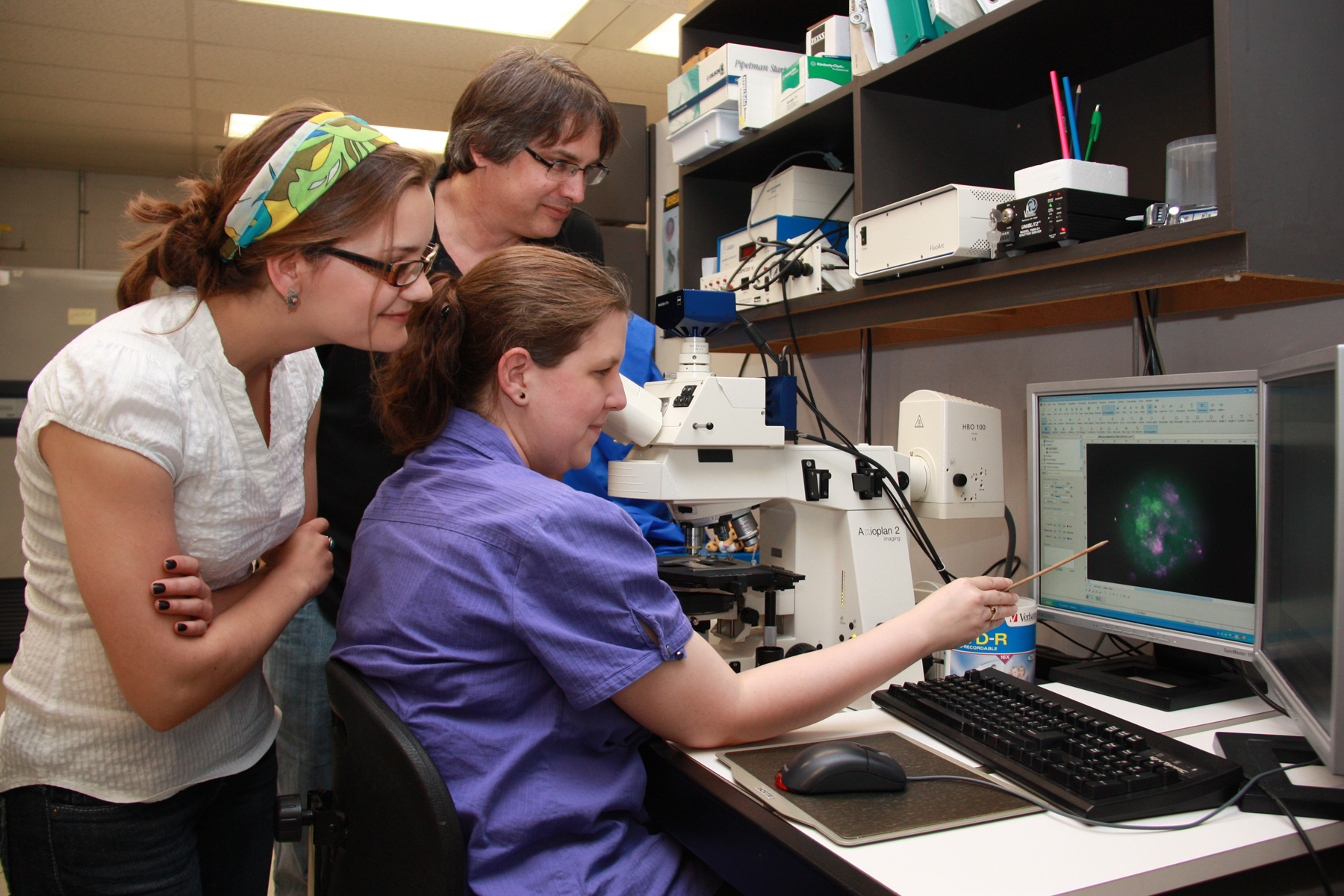
Cynthia Solek's exit from her first lab was so inelegant that she left science completely.
Solek was finishing her master's, expecting to stay in her lab and transition to a doctoral program, when she learned that her supervisor had denied her transfer. She was stunned. (She later realized that her project didn't fit with his evolving scientific interests.) The news clouded what she had thought was a sunny future, and meant she had to write a master's thesis-which she did after taking a job at Second Cup to pay the rent.
Months later, Solek had come to think her bumpy lab departure reflected her general attitude toward science rather than one bad experience of it. She took a new job at the Canadian Cancer Society's Smoker's Helpline, but felt unfulfilled. A year passed, and she reconsidered science. She responded to a Workopolis ad for a lab technician and soon found herself studying the sea urchin genome in the lab of Dr. Jonathan Rast, a senior scientist in molecular and cellular biology at Sunnybrook Research Institute.
Reinvigorated, Solek applied to the University of Toronto as a doctoral student and was accepted into the department of medical biophysics, where Rast is an associate professor. Now close to finishing her PhD, she explains how she is preparing to leave the Rast lab--gracefully.
Will you stay in touch with Dr. Rast?
Yes! Jonathan is really passionate about the science he does-that's one of the things that made me want to stay in his lab and get my PhD. I want to preserve a connection to that excitement we share about science, even if I go on to work in a different field of science.
He would be open to that?
I think so. He's very "open door." We basically barge into his office at any time of day and say, 'Hey, what about this?' Of course, I will need to get references from him for my future endeavors, but I expect we'll continue to exchange knowledge as well.
Will you stay connected with other colleagues?
Yes, the networking we have at Sunnybrook -- with all these exciting fields of research -- it's good to have a link to that, for sure. I'm also in touch with several summer students we've had and two of our ex-postdocs, one in California and one in Japan. Our paths may cross again, and it's much easier to collaborate when you've already worked with someone.
Are there experiments you won't finish?
I'm hoping not. I've been talking with Jonathan about finishing projects. A new student, Catherine Schrankel, started last September and she'll take over where I leave off. We're overlapping just enough for her to learn what I've been doing and to complete unfinished projects. But I should be able to wrap up most of my work, then write a manuscript.
Will that be the last paper for you in this lab?
No. There are one or two other projects I've had my hand in, so I may get third or fourth author on those. I'm more than happy to help out with experiments whenever I can.
What will you miss most about the Rast lab?
Sharing successes and failures with my lab members, and exchanging advice on experiments. Even though our projects don't tend to overlap, we often troubleshoot together, whereas some labs are competitive between students and don't share much. We avoid those kinds of relationships.
What's next for you?
I'm applying to postdoctoral positions in several developmental biology labs. My husband-I'm recently married-works in pharmacy, which as a field offers more possibility in Canada than most other countries, so we'd like to stay here. But we're open to leaving. It's a little unnerving not knowing exactly what's coming next, but at the same time it's exciting because anything can happen.
What advice would you give to young graduate students?
I think that finding the right project is really important to maintain the enthusiasm required to do science. I can no longer imagine doing any other work.
|
|
 Nexus Summer 2011
