




Scientist profiles A-F
Spotlight on
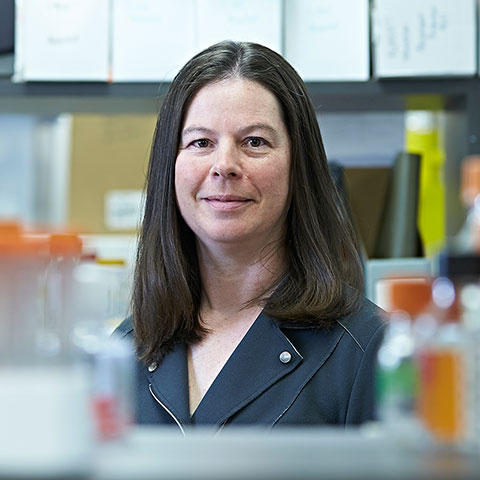
Dr. Isabelle Aubert
Aubert is a senior scientist in Biological Sciences at SRI. The focus of her research is the brain. She aims to develop therapies that prevent loss of brain cells and promote growth of new neurons in Alzheimer’s disease and other neurodegenerative diseases. In July 2019, she was awarded a one-year Project Grant worth $100,000 from the Canadian Institutes of Health Research. She will investigate the possibility of using genetically engineered brain cells to make antibodies that fight the toxic proteins of Alzheimer’s disease.
SRI profiles
- Agessandro Abrahao
- Neill Adhikari
- Gili Adler Nevo
- Muna Al-Khaifi
- Fahad Alam
- Raed Alhusayen
- David Alter
- Andre Amaral
- Nisha Andany
- Michele Anderson
- David W. Andrews
- Pamela Angle
- Federico Angriman
- Oleh Antonyshyn
- Shady Ashamalla
- Elizabeth Asztalos
- Clare Atzema
- Isabelle Aubert
- Bourne Auguste
- Peter Austin
- Amir Aviram
- Imad T. Awad
- Jetan Badhiwala
- Colleen Bailey
- Elizabeth (Toni) Barnes
- Andrew Bayley
- Mary Bell
- Ferco Berger
- Neil Berinstein
- Anne Berndl
- Scott Berry
- Junaid Bhatti
- Alexander Bilbily
- Paul Binhammer
- Catherine Birt
- Georg Bjarnason
- Sandra Black
- John Blakely
- Michael Bonares
- Susan Bondy
- Mark I. Boulos
- Fred Brenneman
- Michael Bronskill
- Susan Bronskill
- Rena Buckstein
- Catriona Buick
- Matthew Burke
- Peter Burns
- Jeannie Callum
- Robert Cartotto
- Saulo Castel
- Michael Catapano
- Adrienne K. Chan
- Kelvin Kar-Wing Chan
- Jesse Chao
- Martin Chapman
- Harman Chaudhry
- Hanbo Chen
- Joyce L. Chen
- Ivy Cheng
- Susanna Yee-Shan Cheng
- Jordan Chenkin
- Sheldon Cheskes
- Amy Cheung
- Christopher Cheung
- Helen Cheung
- Matthew Cheung
- Patrick Cheung
- Hall Chew
- Mark Chiew
- Lee Chin
- Stephen Choi
- Edward Chow
- Signy Chow
- George Christakis
- William Chu
- Brige Chugh
- Hans Chung
- Paige Church
- Natalie Coburn
- Carole Cohen
- Lawrence B. Cohen
- Brian Courtney
- Allan Covens
- Eugene Crystal
- Charles Cunningham
- Brian H. Cuthbertson
- Andrew Czarnecki
- Gregory Czarnota
- Leodante da Costa
- Luis Teodoro da Luz
- Alain Dabdoub
- Craig Dale
- Nick Daneman
- Elizabeth David
- Carlo DeAngelis
- Saswata Deb
- Susan Deering
- Christine Démoré
- Jana Dengler
- Jay Detsky
- Chris Dey
- Andrew Dimitrijevic
- Deepak Dinakaran
- Mark Doherty
- Michelle Downes
- Ian Drennan
- Sascha Drewlo
- Lisa Dubrofsky
- Andrew Dueck
- Craig Earle
- Andrea Eisen
- Janet Ellis
- Debbie Elman
- Urban Emmenegger
- Danny Enepekides
- James England
- Antoine Eskander
- Ed Etchells
- Anthony Feinstein
- Jeffrey Fialkov
- Lee Fidler
- Joel Finkelstein
- Karen Fleming
- Michael Ford
- Michael Ford
- Stuart Foster
- Robert Fowler
- Stephen Fremes
- Lei Fu
- Vera Fung
